
- This event has passed.
#TalkRadio – May 13: You Have the Power to Save Lives: Addressing The Black overdose Crisis in America
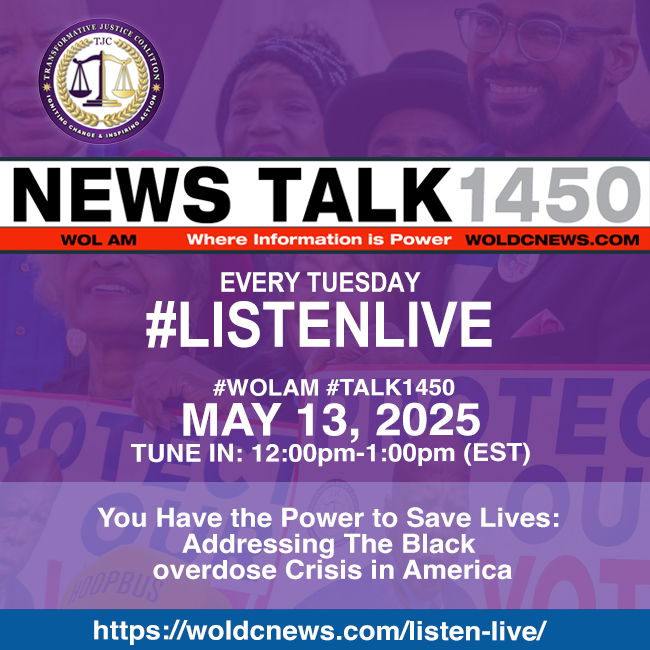
May 13, 2025: You Have the Power to Save Lives: Addressing The Black overdose Crisis in America
The nonpartisan “Igniting Change Radio Show with Barbara Arnwine, Esq. and Daryl Jones, Esq.” program will be aired from 12:00 p.m. to 1:00 p.m. Eastern Time (ET) on Radio One’s WOL 1450 AM in the Washington, DC metropolitan area as well as nationwide on WOLDCNEWS.COM and Barbaraarnwine.com.
Please note, during the show there are 3 hard stop commercial breaks at 12:13 PM Eastern Time, 12:28 PM ET and 12:43 PM ET.
SPEAKERS:
Tracie Gardner: 12:00 PM – 12:57 PM ET
Executive Director of the National Black Harm Prevention Network
Dr. Wanda Boone: 12:00 PM – 12:57 PM ET
CEO of Together for Resilient Youth and the lead of the You Have the Power to Save Lives campaign in North Carolina
INTRODUCTION:
Hi Igniters For Change! The Igniting Change Radio Show on Tuesday, May 13th, 2025, from 12:00 PM – 1:00 PM Eastern Time, entitled “You Have the Power to Save Lives: Addressing The Black overdose Crisis in America”, with Radio Show Co-Hosts and Transformative Justice Coalition (TJC) Co-Leaders Attorneys Barbara Arnwine, Esq. and Daryl Jones, Esq. will feature special guests Tracie Gardner and Dr. Wanda Boone.
According to the briefing paper by the National Black Harm Reduction Network and Vital Strategies entitled “Left Behind: Black Overdose Rates Surge as National Deaths Decline” (hereinafter cited as “Briefing Paper”), “[d]rug overdose is the leading cause of preventable death for Black adults in the United States, more than gun violence or car crashes. Unpredictable drug supply and the presence of synthetics like fentanyl places everyone at risk regardless of frequency and type of drug use. The overdose crisis is often portrayed as a white issue. But overdose rates among Black individuals have been rising for a decade, surpassed death rates in white communities in 2020, and have surged over the last 5 years.”
According to a Vital Strategies article entitled “Q&A with Tracie Gardner, Executive Director of the National Black Harm Reduction Network” by Kyli Rodriguez-Cayro further elaborates that in 2024, “the United States witnessed a decline in overdose deaths for the first time in five years—an estimated 25% decrease through October 2024, based on the most recent data available. While this overall trend is positive news, it is not experienced equally: Black and Indigenous communities across the country remain disproportionately affected by fatal overdose. This pattern is reflected in the seven states where Vital Strategies’ Overdose Prevention team is currently working. For example, in North Carolina, overdose deaths declined by 27% overall from September 2023 to September 2024, but increased in Black communities. Similarly, fatal overdose in Kentucky fell by 10% in 2023, but increased by 5% among Black Kentuckians.
According to the latest data that Vital Strategies has on overdoses in Baltimore and DC, from January 1, 2018, through June 30, 2024, the DC Medical Examiner investigated 2,515 opioid overdose deaths. Their study found that 84% or 2,126 of those who died were Black. On average, there were 17 opioid-related fatalities per month in 2018 and 23 opioid-related fatalities per month in 2019. This rate increased to 38 deaths per month in 2022 and 43 deaths per month in 2023. The overdose crisis has also been devastating in Baltimore, where overdoses were at the highest level for any major American city. In the past six years, nearly 6,000 lives have been lost. The death rate from 2018 to 2022 was roughly double that of any other large city, with a significant portion of these deaths occurring in the Black community.
According to the Briefing Paper, “[i]n the vast majority of states where recent data is available by race, Black communities suffer higher fatal overdose rates than white populations. Black men age 54 to 73 years are four times more likely to die from overdose than other men in their age group. Structural racism, manifesting through policies and practices that systematically disadvantage Black populations, exacerbates these disparities. For instance, from 2019 to 2020, overdose death rates increased by 44% among non-Hispanic Black individuals, surpassing the rate among non-Hispanic White individuals for the first time in over two decades. Traditional harm reduction and substance use disorder treatment programs often fail to effectively engage Black individuals due to a lack of cultural tailoring. The absence of culturally specific outreach results in lower utilization of these services by Black communities. Among those who died from overdose in 2020, Black individuals were least likely to have ever participated in substance use disorder treatment, although they were most likely to die in communities with a high availability of treatment providers. Misinformation and stigma surrounding substance use disorders contribute to reluctance within Black communities to seek help. Historical and ongoing experiences of discrimination and mistreatment in healthcare settings have fostered deep-seated distrust of providers among Black individuals. This distrust is compounded by fears of legal repercussions, as drug policies have historically criminalized drug use in Black communities more harshly than in others. Consequently, Black individuals may be less likely to seek life-saving interventions or participate in substance use health services and overdose prevention programs. The percentage of Black individuals who received substance use disorder treatment was lower compared with White individuals. Geographic disparities also exist, with non-Hispanic Black individuals experiencing higher rates of drug overdose deaths in urban counties compared to rural ones. In 2020, the rate of drug overdose deaths among non-Hispanic Black individuals in urban counties was nearly double that in rural counties.
“Addressing these systemic barriers requires comprehensive strategies that include:
-
Developing and implementing culturally specific outreach, overdose prevention, and treatment programs.
-
Building trust between Black communities and healthcare providers.
-
Ensuring equitable access to medication treatment and substance use health services.
-
Addressing socioeconomic inequities that contribute to health disparities.
“By acknowledging and actively working to dismantle these structural barriers, we can move toward reducing overdose deaths and achieving health equity in Black communities.”
Implementing these strategies is our guests. Wanda Boone wrote an op-ed in Indy Week entitled “Durham County’s Next Hurdle in the Opioid Battle: Reaching Every Community” outlining her work in Durham County, North Carolina. Wanda’s organization, “Together for Resilient Youth (TRY), contacted then–Attorney General Josh Stein to highlight the lack of opioid messaging for Black communities. Stein attended a meeting where we presented Durham-specific data, and after seeing the disparities firsthand, he updated and enhanced his public messaging to better reflect the crisis in Black communities. This shift helped ensure that the opioid epidemic was no longer discussed as solely a white issue, but as one affecting all racial groups…Rather than relying solely on outside interventions, my organization, TRY, a Durham-based coalition tackling substance use prevention, trains trusted community members—faith leaders, educators, business owners, parents, and those with lived experience—to spread awareness and distribute naloxone. We know that childhood adversity—abuse, neglect, parental incarceration—dramatically increases the risk of substance use later in life, and the opioid crisis is emblematic of that. In Durham, harm reduction isn’t just about reversing overdoses. It’s about preventing them in the first place. That means addressing social determinants of health and making sure residents have access to the full spectrum of care, from prevention to recovery. One of the most promising alliances is with the Black church, which has long served as a pillar of trust and support. On March 24 we held the first in a series of Zoom meetings with faith leaders to address substance use in their communities and congregations. The goal is simple but profound: make naloxone as commonplace as a first-aid kit in places of worship…Public awareness campaigns are another key piece of the puzzle. Billboards, social media campaigns, and public service announcements have proven effective in other communities, but they remain underfunded in Durham’s Black neighborhoods. North Carolina’s harm-reduction efforts have come a long way. Since 2017, the number of substance-use programs statewide has grown from 29 to 50. Naloxone distribution has
expanded. But the work is far from over. Every resident needs to understand it just takes one
spray to save a life.”
Tracie Gardner is the Executive Director of the National Black Harm Reduction Network. Daliah Heller is Vice President of drug use initiatives at Vital Strategies. Together, they wrote an article in the Washington Informer entitled “Preventing Overdose Deaths in Black Communities” describing the importance of Naloxone and are launching, with community partners like TRY, a seven-city “Naloxone in Black” media campaign in late March to promote access to the lifesaving medication. Their campaign will focus on Philadelphia, Newark, Milwaukee, Detroit, Louisville, Durham, and Albuquerque.
We are not powerless in the opioid crisis, as they reminded us at the end of their article: “Every overdose death is a preventable tragedy. With naloxone in hand, you can save a life.”
QUESTIONS:
12:00 PM – 12:15 PM ET
[CURRENT EVENTS SEGMENT]
12:15 PM ET
- Switching now to today’s topic, Tracie Gardner, welcome to our show and thank you so much for being here to discuss this very serious issue of life and death for too many African-Americans. Please tell our audience what is the opioid crisis?
- Tracie, how does this crisis affect the African-American community in particular?
- Dr. Wanda Boone, welcome to the show. We know you have been doing some incredible work in Durham. How did you get involved with this work?
- Tracie, can you tell us more about the story of Kimberly Douglas and her son Bryce?
- Tell us about your programs. What are some of the strategies you’re using, respectively, in your programs?
- Tracie, the You Have the Power to Save Lives campaign operates in seven cities – Newark, Milwaukee, Detroit, Philadelphia, Louisville, Durham, and Albuquerque. Tell us about those seven cities and why these are the priority cities.
- Tell us about the different programs in each city.
- Dr. Boone, you lead the Durham program. Tell us specifically about that campaign.
- We have a large part of our audience in Washington, D.C. and Baltimore. What should they know about the opioid crisis in these areas?
- Let’s talk about the role of race in this hidden crisis. How do you believe the role of race accounts for the national neglect on this issue?
- Please tell us why Naloxone is so critical to the protection of lives to those who are fighting opioid addiction.
- If you are a parent or a friend of someone who you know is part of the opioidh crisis, what do you need to know? How can people be prepared to protect lives?
- We know about your work with the Black churches. How do you hope to amplify this campaign in the future?
- How can our audience get involved in your campaigns?
- One of the issues is the stigma- what are your best recommendations for how to address the stigma that prevents so many people from getting help?
- How can our listeners get involved?
- What are your one-minute final thoughts to our listeners?
- Thank you so much for joining us today. How do our listeners get in contact with you?
[Let’s talk about what’s going on with the SAVE Act. Is voting a privilege or right?! Arnwine will remind listeners when you make those daily calls to the Congress at 202-224-3121, be sure to tell your Senator to say NO to the SAVE Act and remind people to stay in those streets!]
[TJC will continue to vigorously defend the rights of all Americans and will fight the implementation of Project 2025 and our future shows will continue to cover any hate crimes and how we effectively protect ourselves while advancing our agenda for justice.]
[Daryl, Barbara, and guests may share their favorite books and encourage people to donate towards TJC’s giveaways of banned and affirming books.]